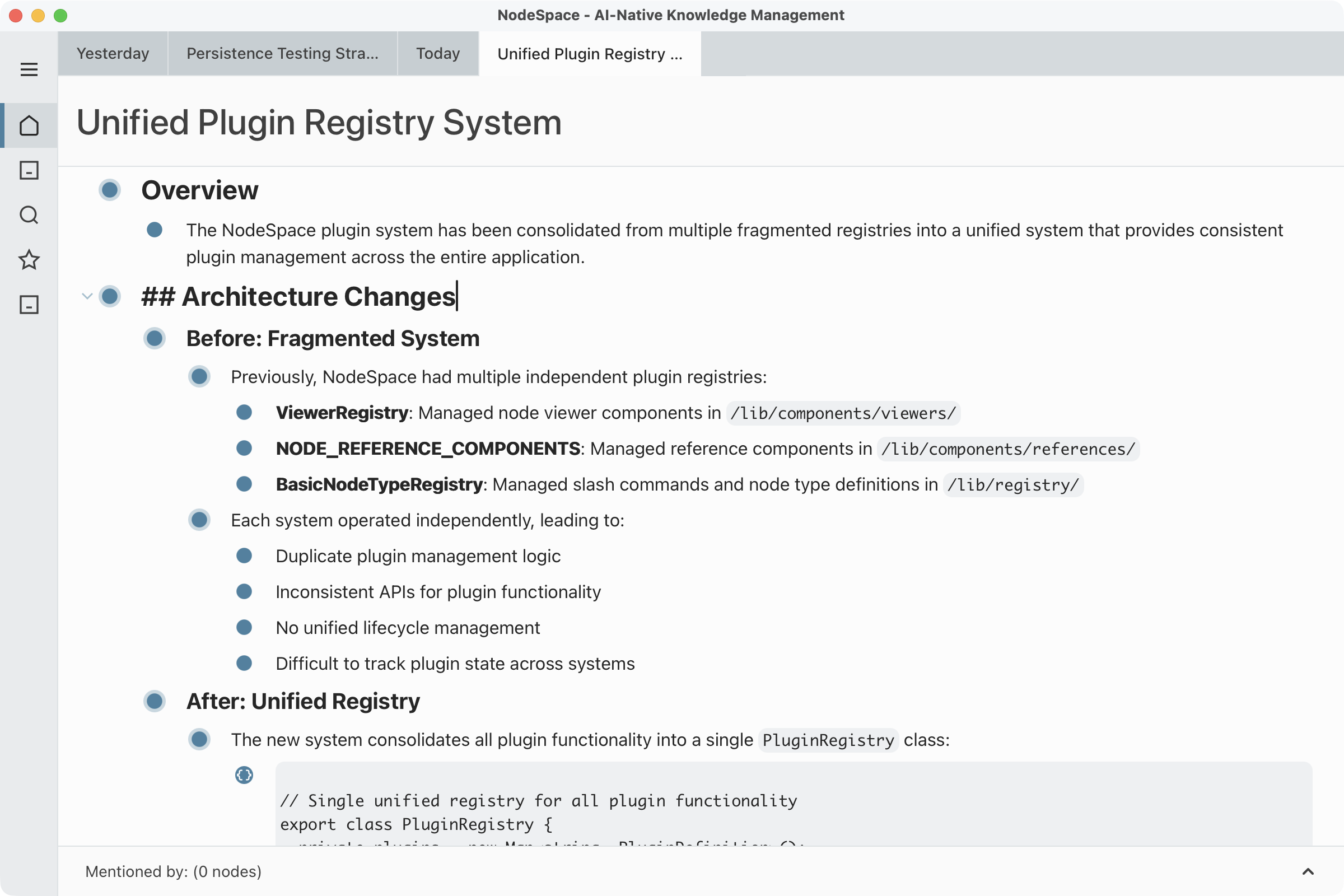
Your AI writes docs directly to NodeSpace. You browse and edit them in the desktop app. Both query the same semantic search - locally, instantly.
Runs entirely on your machine. No cloud accounts, no API calls, no data leaving localhost. Open source. Inspect the code yourself.
*Benchmarked against grep/ripgrep on local markdown docs
You re-explain your architecture every session. Context compacts, knowledge disappears.
Keyword-only. Multiple roundtrips. Burns tokens searching for what might not even match.
Notion, Linear, Jira - API calls for every lookup. No semantic search, just keyword matching.
NodeSpace: local semantic search. One config line. Your AI finds the right context in milliseconds.
Embeddings and database built-in. No cloud account, no API keys, no setup.
Add NodeSpace to Claude Code, Cursor, or any MCP-compatible assistant:
"nodespace": {
"type": "http",
"url": "http://localhost:3100/mcp"
}
Import existing docs, or let your AI write directly to NodeSpace. Your knowledge base grows as you work.
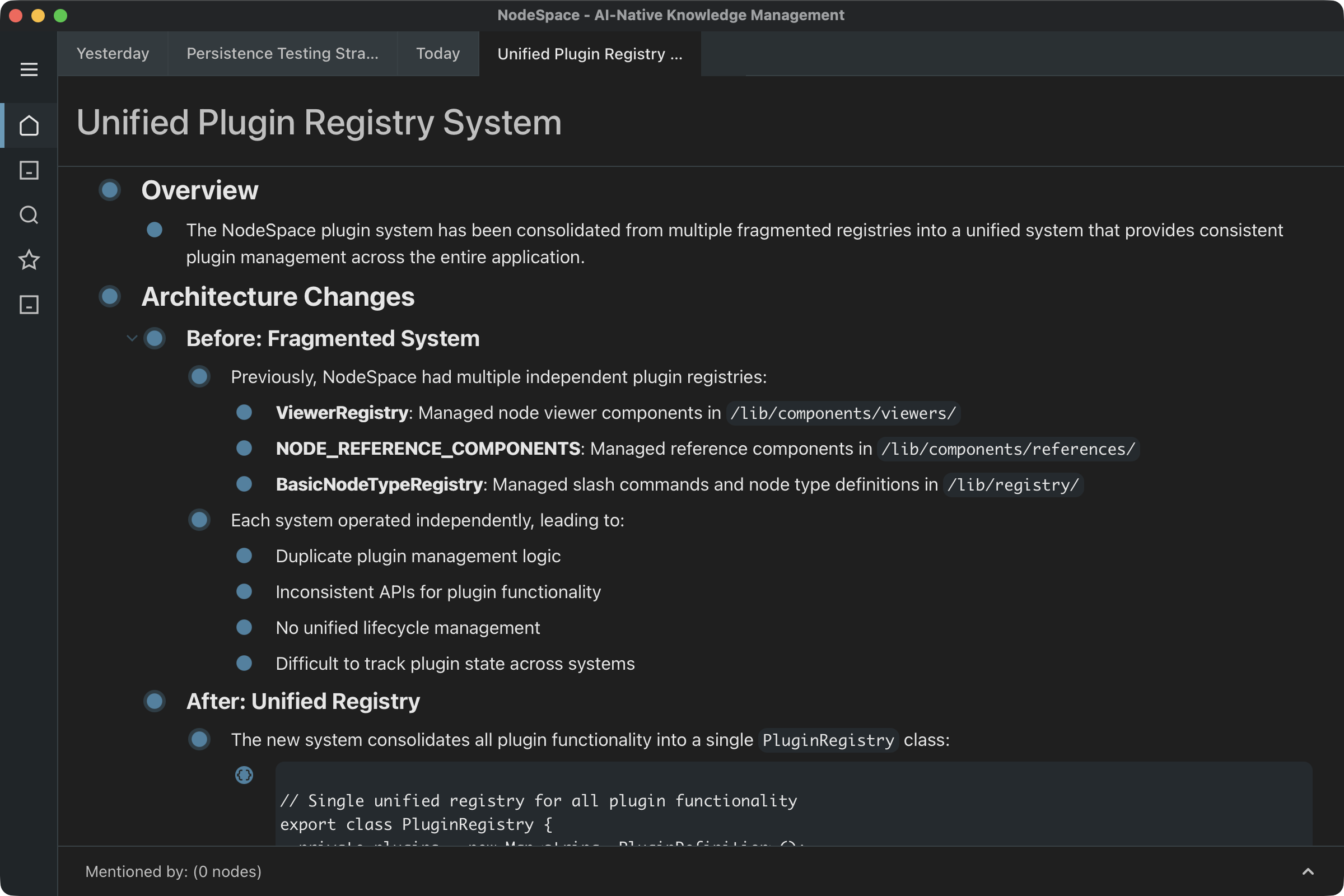
Desktop app for humans to browse and edit. MCP server for your AI to read and write. Both work together.
NodeSpace runs locally. No per-request API calls, no token overhead for context lookup. Works offline, on planes, behind VPNs.
Ask "Where do we handle authentication?" and get the right files - even if they don't mention "auth" in the name. Semantic search, not keyword matching.
Drop-in integration via MCP protocol. Claude Code, Cursor, Continue - no switching editors or changing workflows.
Compatible with any AI provider - OpenAI, Anthropic, local models. NodeSpace provides the context, you choose the model.
Share your knowledge base across your product team. Everyone's AI stays informed, no manual syncing.
Define reusable workflows that execute automatically. Describe what you want, NodeSpace runs it on triggers you set.
Early access users help shape what we build next.
Same question, two approaches - watch the difference
Join the waitlist - no commitment, no credit card